
I recently wrote a piece on rejection sensitivity, and while trying to find a metaphor to describe the term transdiagnostics, I came across two of the internet’s greatest cultural frameworks: the Cube Rule of Food and the Sandwich Alignment Chart (more on that in a second). After I finished writing, I realized this wasn’t just a funny throwaway analogy. It is actually a clear and interesting way to explain a big challenge in modern mental health treatment. So, here goes nothing.
We’ve all seen the TikToks and Reels. A relatable creator stares at a pile of laundry or a half-finished email draft, sighing about how their brain has thirty open tabs, three of them are frozen, and there’s music playing from an unknown source.
The comment section inevitably reads: “Oh no, do I have ADHD?”
It’s a fair question. Brain fog and a total inability to sit still or focus are deeply frustrating experiences. But if you walk into a psychiatric clinic and say, “I can’t focus,” jumping straight to an ADHD diagnosis is like ordering a sandwich, getting a hot dog, and calling it a day.
To understand why, we need to talk about transdiagnostics—a fancy medical framework that recognizes how individual symptoms (like a broken focus dial) cut across multiple psychiatric diagnoses rather than belonging exclusively to just one. The metaphor I came up with in my previous rejection sensitivity post was that transdiagnostics is like using flour as an ingredient in bread, cake, pasta, and pizza dough. Flour is essential to all of those recipes, but knowing something contains flour doesn’t tell you what you are eating.
Part 1: The Sandwich Alignment Chart of Psychiatry
Here it is in all its glory:
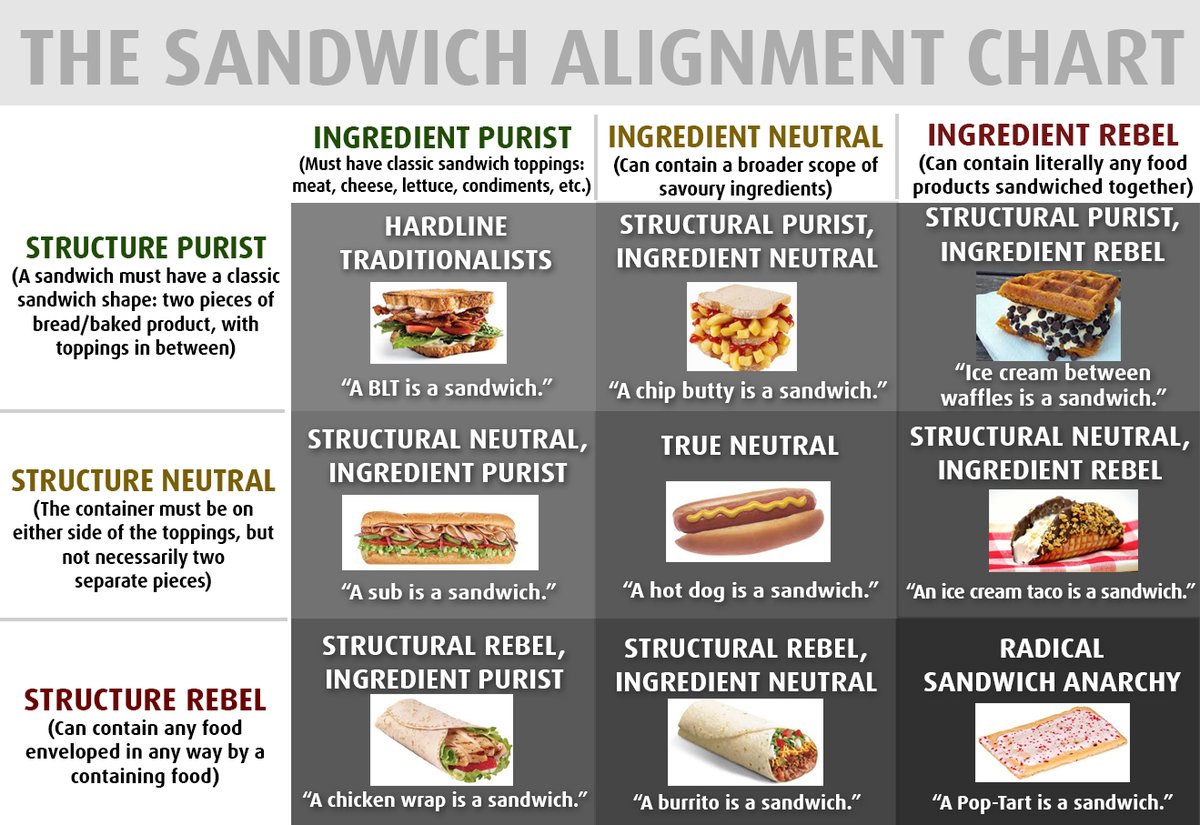
If you arent familiar with the chart, it breaks down like so:
- Structure Purist / Ingredient Purist: Only a traditional ham and cheese on sliced bread counts as a sandwich.
- Structure Rebel / Ingredient Rebel: A Pop-Tart is a sandwich. An Oreo is a sandwich. Everything is a sandwich.
For decades, traditional psychiatry operated like a Structure Purist. The Diagnostic and Statistical Manual of Mental Disorders (DSM) drew neat little boxes. If you have Symptoms A, B, and C, you are in the ADHD Box. If you have Symptoms D, E, and F, you are in the Depression Box. The boxes weren’t supposed to touch.
But human brains are notorious for their rebellious streak. They don’t care about structural rules.
Enter the Transdiagnostic Approach, the Structural Rebel of mental health. It challenges the idea that every psychiatric diagnosis is a completely distinct entity. Instead, it looks at the underlying biological processes, emotional patterns, and symptoms that overlap between conditions.
When you tell a transdiagnostic clinician “I can’t focus,” they don’t just hand you an ADHD screener. They recognize that inattention is a transdiagnostic symptom. It’s a carbohydrate exterior that could be wrapping a dozen entirely different fillings.
Part 2: The Cube Rule of “Inattention”
To figure out why your focus is broken, we have to apply the Cube Rule. For the uninitiated, the Cube Rule states that all food can be classified into six archetypes based on where the structural starch (the bread or crust) is placed.
In our metaphor, the core symptom—inattention—is the starch. Here is how the exact same symptom changes structural meaning depending on what is actually causing it:
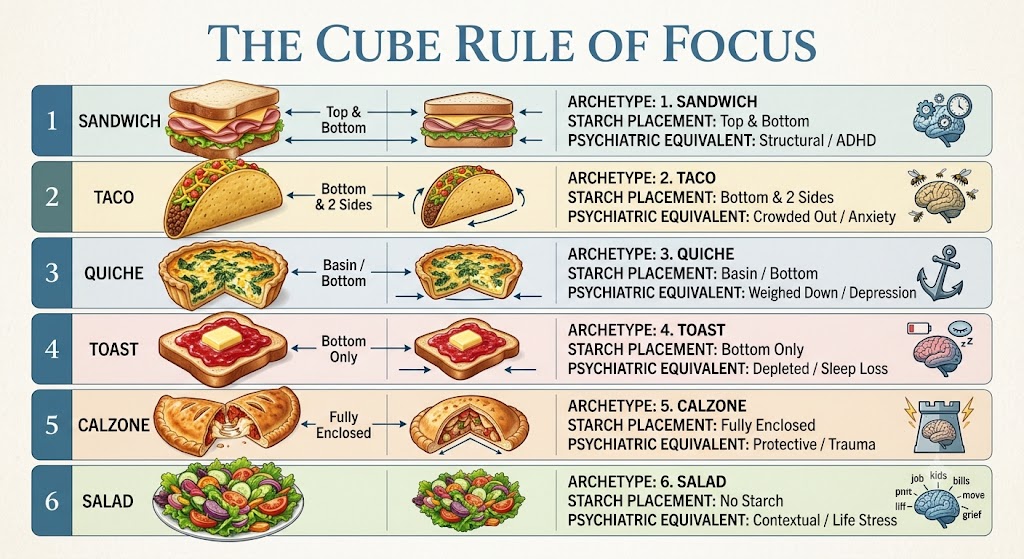
The transdiagnostic approach uses the Cube Rule to show that just because you see “starch” (a symptom like difficulty focusing), you cannot immediately assume you are looking at a standard sandwich (ADHD).
Let’s look at how the exact same symptom of “difficulty focusing” changes structural meaning depending on what is actually causing it.
1. The Sandwich (ADHD)
- The Structure: Starch on top and bottom—rigid, permanent, lifelong.
- The Filling: Dopamine deficit and executive dysfunction. Unremitting.
- The Reality: Classic, textbook ADHD. To be a true “ADHD Sandwich,” the symptoms must be persistent across your life and show up in multiple settings (home, work, school). The DSM-5 notes that people with ADHD are preferentially drawn to novel, high-stimulation activities, but the core issue is broader than just chasing shiny objects.
- Key Differentiator: The DSM-5 requires symptom onset before age 12, but this criterion is an active area of debate. Recent research highlights late-onset ADHD as an unresolved diagnostic question, with longitudinal studies identifying adults who meet full criteria whose symptoms only emerged later in life. While the age-of-onset rule remains a great tool for separating lifelong neurodevelopmental ADHD from acquired inattention, the “expiration date” on the sandwich can be smudged. That’s why checking the filling—mood, anxiety, trauma, and sleep—is so vital.
2. The Taco (Anxiety)
- The Structure: Starch on the bottom and two sides, open at the top.
- The Filling: Chronic worry, physical restlessness, endless mental loops of overthinking and catastrophizing
- The Reality: The inattention is pushed upward and outward because it’s being crowded out by an overflowing filling of dread. You can’t focus, not because your brain lacks dopamine, but because it’s currently being held hostage by a swarm of bees. Your brain is too busy simulating 45 worst-case scenarios to care about a spreadsheet.
- Key Differentiator: In anxiety disorders, inattention is driven by worry, constant rumination, and mental preoccupation. Your brain is too busy simulating 45 worst-case scenarios to care about your spreadsheet.
3. The Quiche (Depression)
- The Structure: Starch holding a dense, heavy custard.
- The Filling: A dense, heavy custard of low motivation, persistent sadness, and anhedonia (inability to feel pleasure).
- The Reality: The inattention crust holds up a massive weight of depressive symptoms that slows processing speed to a crawl.
- Key Differentiator: Depressive inattention is typically episodic, tied to mood cycles rather than tracking back to childhood. NOTE: Cognitive recovery after depression is often incomplete. Research shows that cognitive deficits—including focus and memory problems—frequently show little improvement even after mood symptoms respond to standard treatment. Furthermore, choice of medication matters. Network meta-analyses indicate that certain antidepressants (like vortioxetine) demonstrate significant cognitive improvement over placebo, whereas many standard SSRIs (like escitalopram or fluoxetine) do not. If an SSRI lifts the emotional fog but leaves the cognitive fog behind, that residual inattention can easily be misdiagnosed as ADHD.
4. The Toast (Sleep Deprivation & Sleep Apnea)
- The Structure: Starch on the bottom only. Single exposed layer.
- The Filling: Systemic exhaustion and oxygen deprivation.
- The Reality: There are no complex emotional fillings here. The “toast” of inattention is lying flat because your brain simply lacks the battery power to stand up. Sleep disorders like insomnia or obstructive sleep apnea mimic ADHD almost perfectly. Fix the sleep, and the “ADHD” often vanishes. (Keep in mind: adults with actual ADHD also report sleep issues as a core feature of their condition, making sleep hygiene essential for revealing the underlying picture).
5. The Calzone (Trauma & PTSD)
- The Structure: Starch fully enclosing the internal ingredients.
- The Filling: Hyperarousal, trauma triggers, and deep emotional pain.
- The Reality: Inattention acts as a thick, fortress-like outer shell designed to keep vulnerable internal trauma hidden. Hypervigilance, irritability, and restlessness look identical to ADHD on the surface. But structurally, the calzone’s shell forms because the brain is scanning the environment for threats, leaving zero bandwidth for sustained attention.
- That said, ADHD and PTSD are not always an either-or situation. Some studies estimate that up to 36% of adults with PTSD also have comorbid ADHD. A 2026 study of over 700,000 youth found that stimulants were actually associated with the most favorable outcomes, even in kids who had both ADHD and PTSD.
6. The Salad (Situational/Contextual Stress)
- The Structure: No starch. No structural container at all.
- The Filling: A brutal work deadline, divorce, a move, grief, financial collapse, or parenting three toddlers.
- The Reality: There is no psychiatric “shell” here. The inattention is real, but it isn’t wrapped in a clinical disorder—it’s a pile of raw life sitting on a plate. The DSM-5-TR categorizes this under Adjustment Disorders. Once the stressor resolves or you adapt, focus typically returns. It’s just a salad that needs time, support, and a break from the chaos.
A Note on Combo-Platters & Diagnostic Overshadowing
Real human brains rarely present as a single, neat menu item. In clinical practice, patients frequently show up as combination platters:
- Genuine ADHD with a side of anxiety.
- Depression wrapped around undiagnosed sleep apnea.
- PTSD layered on top of a lifelong neurodevelopmental condition.
When conditions overlap, they don’t sit quietly in separate compartments on your plate… they fuse. Think of it like a Kimchi Quesadilla. The sharp heat of the kimchi blends into the melted cheese inside the tortilla. You can’t separate them without making a mess, and together they create a completely unique flavor profile. In psychiatry, this is comorbidity: your anxiety alters how your ADHD looks, and your ADHD actively feeds your anxiety.
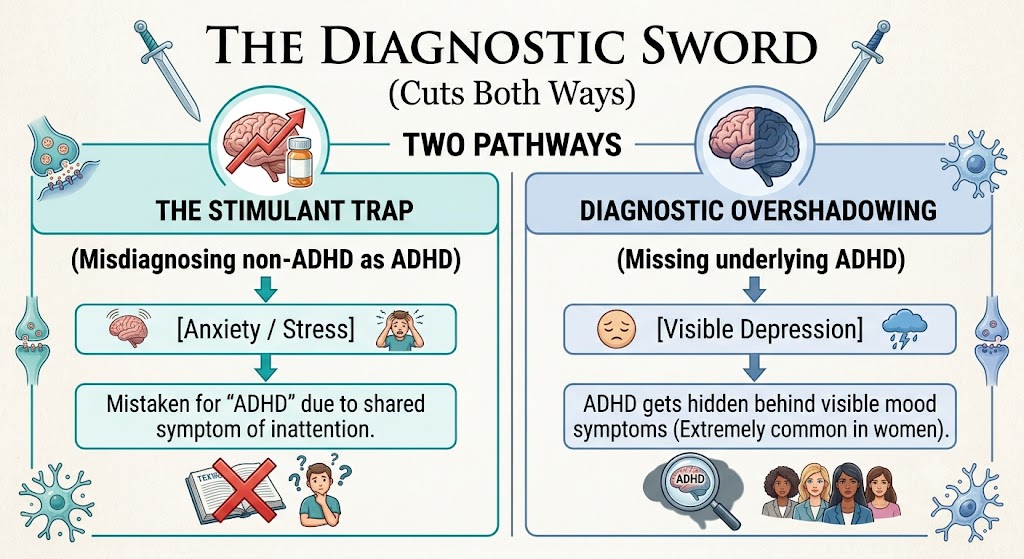
This brings us to Diagnostic Overshadowing—the inverse of the stimulant trap.
While much of the public debate focuses on mistaking anxiety for ADHD, the reverse happens just as often. A patient presents with obvious anxiety or depression, gets treated for it, and nobody ever checks to see if an ADHD sandwich was hiding underneath the whole time.
This is especially common in women and girls. Research shows young females are significantly more likely to be treated with antidepressants before ever receiving an ADHD evaluation, as their symptoms tend to manifest as internalizing distress rather than overt hyperactivity. The transdiagnostic lens cuts both ways: it should make us careful before diagnosing ADHD, but equally cautious before ruling it out when another condition is present.
The “Vibe Check” Diagnosis is Clinically Dangerous
Because symptoms overlap heavily, diagnosing someone off a single complaint is risky. The DSM-5-TR explicitly warns that ADHD should never be diagnosed if symptoms are “better accounted for by another mental disorder.”
If we rely on a surface-level approach, we fall directly into The Stimulant Trap.
Someone takes a friend’s Adderall, focuses for eight hours, and concludes, “Aha! Proof I have ADHD!” But a positive response to a stimulant is not a diagnostic confirmation.
The Prefrontal Dimmer Switch
To understand why, we look at the inverted-U dopamine model. The prefrontal cortex—the area responsible for planning, organizing, and filtering distractions—is exquisitely sensitive to dopamine:
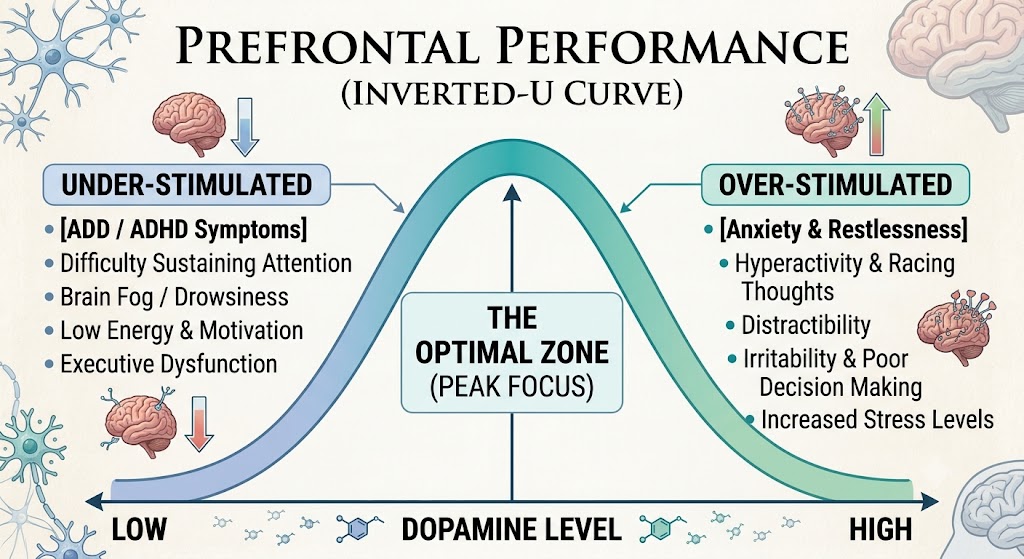
- In ADHD: The prefrontal cortex sits on the far left side of the curve. Dopamine is too low, leaving neural networks noisy and underconnected. A stimulant increases dopamine, moving the brain toward the optimal peak. The result is genuine cognitive enhancement: clearer synthesis, organized thought, and better sustained attention.
- In a Neurotypical Brain: Prefrontal dopamine is already near the peak. Taking a stimulant pushes the brain past the optimal zone into overstimulation. While deeper reward and arousal circuits respond—giving a surge of energy, motivation, and reduced fatigue—prefrontal processing doesn’t actually improve. It can even degrade fine analytical performance.
Stimulants also tend to introduce an overconfidence effect. Research on cognitive enhancers shows they can induce strong overconfidence in one’s performance. The drug doesn’t necessarily make you work better; it makes you feel like a genius while doing it. The neurotypical student who takes Adderall feels energized and deeply engaged, but objective measures show their output quality is unchanged. They simply had the artificially induced motivation to sit there and do it.
The Safe Kitchen Strategy
When healthcare providers look at a complicated symptom profile through a transdiagnostic lens, they usually recommend a three-part approach for adults:
- Check the Expiration Date: Confirm whether focus issues actually trace back to childhood, while keeping an eye out for potential late-onset presentations.
- Use a Wide-Angle Lens: Screen broadly across domains using comprehensive tools rather than relying on narrow, single-condition screeners.
- Account for Instrument Blindspots: Be aware of the limitations in common self-report scales. For example, on the widely used Adult ADHD Self-Report Scale (ASRS), research shows over half of patients with clinical anxiety screen positive for ADHD, even though only a small fraction actually have the condition. Items like “difficulty relaxing” or “feeling driven by a motor” often load more strongly onto anxiety factors than ADHD factors. The screening instrument itself struggles to separate the sandwich from the taco.
- Treat the Most Impairing Condition First: Older clinical advice suggested treating mood or anxiety disorders first before addressing focus issues. However, updated guidance from the Society for Developmental and Behavioral Pediatrics (SDBP) recommends identifying which condition causes the most functional impairment and treating that first. Stimulants rarely worsen anxiety and frequently improve both ADHD and co-occurring anxiety symptoms simultaneously. Treating the primary driver first clears the clinical picture, allowing you to see what underlying structure remains.
The Epidemiological Picture
Recent estimates suggest adult ADHD prevalence in the U.S. may be as high as 14.6% under DSM-5 criteria, compared to international benchmarks around 2.8%. Part of this shift stems from the DSM-5 broadening diagnostic boundaries—raising the age of onset from 7 to 12 and lowering the adult symptom threshold—which alone produced a 65% increase in potential diagnoses in sample studies.
When base rates reach this level, the transdiagnostic sorting problem becomes urgent:
- Higher False-Positive Rates: Broader criteria mean individuals with inattention driven primarily by sleep loss, stress, or anxiety are easily captured by general screeners.
- Higher Comorbidity Rates: As more individuals meet criteria, true “combination platters” grow proportionally, making a careful, multi-layered assessment essential.
The Takeaway
Mental health isn’t a pre-packaged Lunchable where every symptom stays neatly in its own divider. It’s a complex, overlapping, fusion-cuisine buffet.
The next time you or a patient are struggling with a broken focus dial, step back and examine the structural alignment. Are you looking at a lifelong neurodevelopmental Sandwich? Or are you dealing with an Anxiety Taco, a Depressive Quiche, or a severe case of sleep-deprived Burnt Toast?
Every brain deserves a thorough evaluation. A hot dog is a hot dog. A quiche could never.