

What is Patrescence: The Transition We Miss

Abstract expressionist painting of two tree forms — one ancient and expansive, one young and reaching — dissolving into warm amber and gold light at dusk, representing the intergenerational bond at the heart of patrescence.

Abstract

We don’t talk enough about what actually happens to a man when he has a kid. It’s not just about “getting used to it.” It’s patrescence—the distinct, biological process of becoming a father. From remodeling neural pathways to shifts in stress hormones, a dad’s transformation is real, measurable, and essential to his child’s development. Let’s dive into the science behind the paternal identity shift and look at why treating fathers like backup caregivers is costing everyone.

We talk a lot about matrescence (and I recently wrote about it on our blog) — the profound identity shift of becoming a mother. And we should. But a parallel transformation is happening on the other side of that relationship, one we barely name in clinical spaces, let alone make room for.

Patrescence is the developmental process of becoming a father.

This isn’t a soft concept or buzzword; the neuroscience is stacking up. And the consequences of ignoring it—for fathers, their partners, and their children—are measurable in a child’s stress physiology decades down the line.

Most men move through this transition into fatherhood without a roadmap. They navigate early parenthood with a low-grade sense of being on the periphery, waiting to be needed, wondering where they fit into this story. They can feel disoriented, but they lack the vocabulary to explain why. There is the pull of a new identity, without language for it. Meanwhile, a clinical system that leaves them in the waiting room and primarily asks them how their partner is doing isn’t helping. An insightful patient of mine shared: “We talk about what we ignore in motherhood. We don’t talk about what we overlook in fatherhood.”

Giving this experience a name moves the conversation out of the realm of personal inadequacy and into the realm of normal human development. When we study the “becoming a father” psychology, we see that this shift changes everything.

A Note on The Scope of This Article

This article focuses on the developmental journey of men becoming fathers, both because this is where the empirical research on patrescence has been conducted and because fathers in heterosexual partnerships remain a population whose perinatal experience is systematically overlooked in clinical care. Critically, the data describes what fathers tend to bring to the caregiving relationship, not what only fathers can bring. Children thrive in many family configurations and kinship networks; the quality of caregiving relationships ultimately matters far more than their structure. Naming what is distinct about fathering does not diminish other family forms. Rather, it fills a massive gap in a clinical system and a body of literature that have historically treated fathers as peripheral, even within the families where they are fully present.

The Biology of Patrescence
Gemini Generated Image ofhhbnofhhbnofhh

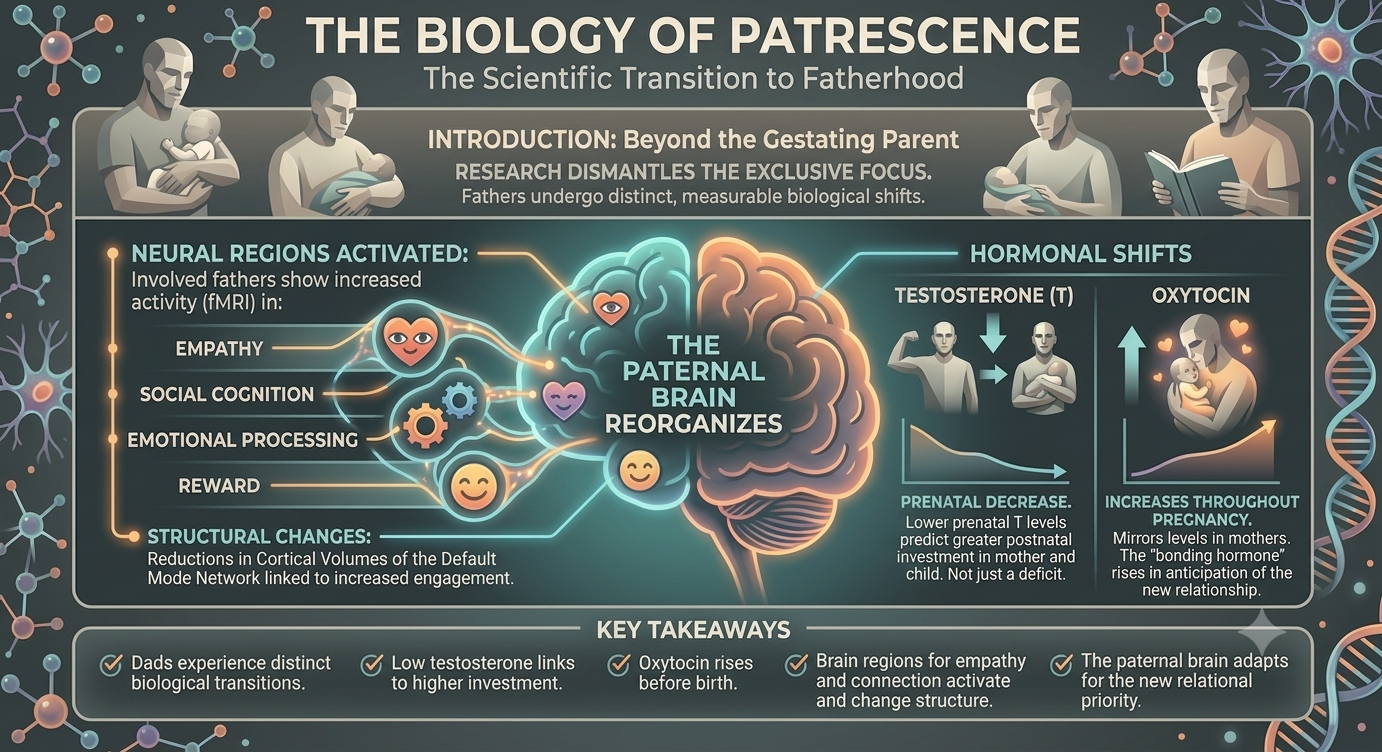
Culturally and clinically, we have conditioned ourselves to think of the perinatal biological transition as something that belongs exclusively to the person who gestates and delivers, but the research has been dismantling that for years.

Expectant and new fathers undergo distinct, measurable hormonal shifts. Research suggests that testosterone tends to decreases during the prenatal period, and lower prenatal testosterone levels predict greater postnatal investment in both mother and child — a finding that tends to surprise people who assume testosterone loss is purely a deficit story. Oxytocin levels increase throughout the pregnancy period in expectant fathers, mirroring what we see in mothers. The hormone associated with bonding, trust, and social attunement is rising in a man who hasn’t yet held his baby, in anticipation of a relationship that hasn’t fully begun.

Brain imaging studies show that involved fathers activate neural regions tied to empathy, social cognition, emotional processing, and reward when viewing images of their children. Preliminary research points to structural brain changes as well — reductions in cortical volumes of the default mode network associated with increased engagement and bonding. The paternal brain, like the maternal brain, appears to be reorganizing itself around this new relational priority.

The Power of Father-Infant Synchrony

Fathers and infants develop biobehavioral synchrony — their oxytocin levels become correlated before and after playful interactions, and dyads rated as more behaviorally synchronous show greater hormonal co-regulation.

A 2026 study using second-by-second behavioral coding found something specific to fathers: dads who responded to their infant’s positive affect with more vigorous, playful touch had higher oxytocin levels — a positive feedback loop that was not found for mothers. The more a father engages physically and playfully with his baby, the more his own biology reinforces and rewards that connection. The caregiving creates the bonding chemistry, not the other way around.

For us as providers, this has a direct clinical implication that we should be acting on more: active caregiving involvement is the mechanism through which the paternal hormonal transition unfolds. When we exclude fathers from early caregiving — when we hand the baby back to the mother by default, when we design hospital protocols around the gestational parent without considering the other — we may be inadvertently blunting the very biological process that supports father infant bonding.

Skin-to-Skin is for Dads, too.

How do fathers bond with their newborns? Skin-to-skin!

A 2026 randomized controlled trial of cesarean-born newborns found that just 45 minutes of paternal skin-to-skin contact significantly improved newborn body temperature, oxygen saturation, heart rate, respiratory rate, and comfort scores compared to routine care. An integrative review confirmed benefits for infant thermoregulation, pain response, and biophysiological markers — alongside meaningful reductions in paternal stress and anxiety.

If you’re a provider, ask yourself: Are we routinely offering this to fathers? Are we making space for it, especially during C-sections when the mother might be unavailable? Paternal skin-to-skin isn’t just a sweet photo op; it’s a clinical intervention with documented biological benefits for both father and child.

A Presence Encoded For Decades

What a father brings to the table is encoded directly into his child’s developing stress system—and that encoding has an incredibly long half-life.

A 30-year longitudinal study found that men who shared more activities with their fathers as children showed healthier diurnal cortisol patterns — stronger circadian rhythm, better stress recovery — in their late 30s. Nearly three decades later. After controlling for socioeconomic status and for their current relationship with their father. The father’s presence in childhood was still visible in the son’s stress physiology as a middle-aged adult.

Coming at it from the other direction: father negativity during infancy was associated with exaggerated infant cortisol stress responses as early as seven months. Father involvement in infancy predicted lower chronic stress — measured by hair cortisol — and fewer behavioral problems in middle childhood.

The Wrestling on the Floor Is Doing Something!

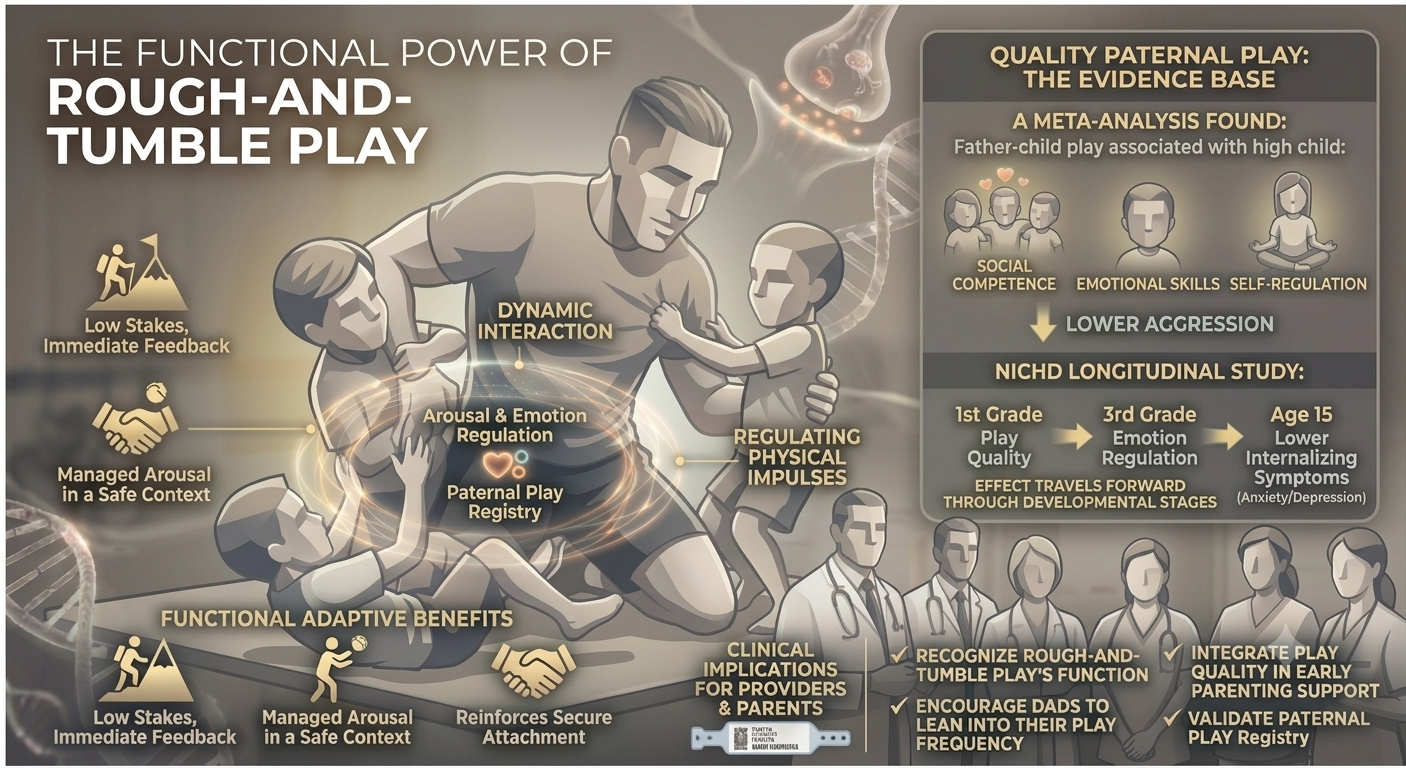
I want to say this directly to the dads: the rough-and-tumble play is not just fun. It has a function that the research has spent considerable effort trying to understand.

A meta-analysis found that quality father-child physical play was associated with better child social competence, emotional skills, and self-regulation, and lower aggression. A longitudinal study using NICHD data found that high-quality father-child play in first grade predicted fewer emotional dysregulation problems in third grade, which in turn predicted lower internalizing symptoms at age fifteen — independent of mother-infant attachment, temperament, and family income. The effect traveled forward in time through multiple developmental stages.

Researchers describe rough-and-tumble play as having a specific biological adaptive function: it teaches children to manage arousal, read social cues, and regulate physical impulses in a safe relational context where the stakes are low and the feedback is immediate. Fathers appear to be uniquely positioned for this kind of interaction — something about the particular quality of paternal play, its energy and its physical register, seems to do something that other interactions don’t replicate in quite the same way.

While caregivers of all genders can engage in this style of play, research consistently finds that fathers, as a group, tend to lean into this specific ‘rough-and-tumble’ frequency and energy, a style that children seem to benefit from in regulating arousal and impulses.
A Father’s Sensitivity Shapes How His Child Thinks

A meta-analysis of 23 studies found that paternal sensitivity was significantly associated with children’s language skills, cognitive ability, executive function, and emotion regulation — not as a secondary contributor to maternal influence, but as an independent one.

  • A father’s responses during serve-and-return interactions at nine months predicted higher receptive language scores at eighteen months. Fathers tend to engage more vocally and physically with children, pushing an infant slightly outside their comfort zone.
  • Early paternal cognitive stimulation at twenty-four months had direct effects on reading and math skills at forty-eight and sixty months.
  • Even at three months of age, the quality of father-infant interaction independently predicted cognitive development at twenty-four months, even after controlling for maternal sensitivity.

The research clearly says that fathers are not backup caregivers, which is something our clinical language has been slow to catch up to. They are essential, independent contributors to their children’s mental development. While mothers and traditional secondary caregivers often orient toward nurturance, soothing, and stabilization, fathers, cross-culturally, orient heavily toward stimulation, exploration, and risk management; this is what psychologists call the activation-relationship.

A Regulated Father Stabilizes the Home

When a father learns to regulate his own nervous system, he becomes an emotional anchor for the entire household.

Studies on intergenerational emotion transmission show that a father’s mindful parenting—specifically his emotional awareness and lack of reactivity when a child is distressed—buffers vulnerable infants from developing behavioral and emotional difficulties later on. His calm isn’t passive; it is an active, protective shield that ripples through the family. The internal work a man does on himself is directly connected to the work he does as a parent.

Father Involvement Protects Maternal Mental Health

A 2025 randomized controlled trial demonstrated that when fathers received infant care training and were actively supported in caregiving participation, their partners showed significantly lower postpartum depression scores at four, eight, and twelve weeks, and higher quality of life compared to controls. A separate large study found that less paternal involvement in childcare was linked to significantly higher rates of maternal postpartum depression. The relationship is probably not as simple as one causing the other (many stressors tend to cluster together), but the trend is consistent across studies and reinforces the same point: supporting fathers in caregiving protects mothers, too.

For providers doing perinatal couples work: supporting fathers in stepping into active caregiving is not just good for fathers. It is one of the most direct protective factors we have for maternal mental health. The two are not separate clinical questions. They are the same clinical question, approached from different angles.

A Father’s Healing May Reach His Children Before They Are Born

Emerging research in paternal epigenetics suggests that a father’s environmental exposures and experiences — stress, diet, substance use, trauma — can alter epigenetic marks on his sperm, and that these changes can be transmitted to offspring. A study found that paternal adverse childhood experiences were associated with specific DNA methylation patterns in their three-month-old infants’ blood, at sites linked to metabolic processes and circadian rhythms — and these epigenetic changes contributed to children’s attention and hyperactivity problems at age three.

This field is young, and we should hold these findings carefully, but its an interesting direction to consider. A father’s healing may not be just for him. It may reach his children before they are even born.

We Are Still Missing Paternal Postpartum Depression

Meta-analyses estimate that approximately eight to ten percent of fathers experience postpartum depression within the first year, with some studies reporting rates as high as thirteen to fourteen percent in the first six months. A landmark 2025 meta-analysis in JAMA Pediatrics — 48 cohorts, 674 effects — found that paternal postpartum depression, anxiety, and stress were associated with poorer child development across global, social-emotional, cognitive, language, and physical domains from infancy through adolescence. The effects were stronger for postnatal than antenatal distress.

Key risk factors include a personal history of mental illness, a partner experiencing depression, relationship dissatisfaction, financial stress, poor sleep, and low social support — a constellation that describes a significant proportion of new fathers, most of whom will never be asked about it.

How often are we screening for this? How often are we asking fathers not how they are supporting their partner, but how they are doing? The question takes thirty seconds. The data suggest it is worth asking.

The Timeline of Patrescence

Like matrescence, patrescence doesn’t wrap up on a neat schedule. A father’s identity takes one to two years postpartum to truly evolve. The first 18 months are frequently marked by role confusion, emotional ambivalence, and that persistent feeling of being on the outside looking in—especially if a partner is breastfeeding.

What my patients who are fathers often say in session is that they want to feel essential, but they don’t know where they fit. They are waiting for an invitation, unsure whether their feelings are normal, and hesitant to speak up because the spotlight rarely falls on them.

If you are feeling identity shifts, role confusion, or deep ambivalence, you are not failing at fatherhood. You are experiencing a massive, normal developmental process.

A Note on the Timeline

The single most important thing to know about patrescence is that it takes much longer than anyone tells you it will. Taking a year or two to find your footing doesn’t mean something is wrong with you; it means you are on a human developmental timeline.

You are navigating this transformation against a cultural backdrop that gives you almost no language for your internal world, a culture that celebrates your practical help but remains completely incurious about your emotional reality.

You are not peripheral. You are not running late. You are in the middle of a massive biological, psychological, and relational restructuring. Your presence, your clumsy attempts to figure it out, and your willingness to stay in the room matter to your child in ways that are lasting, measurable, and entirely irreplaceable.

You aren’t a supporting actor in the story of your family. You are becoming a father. And that is its own profound thing entirely.

This post draws on peer-reviewed research in developmental neuroscience, perinatal psychiatry, epigenetics, and developmental psychology. Sources available on request. If you are a father experiencing symptoms of depression or anxiety in the perinatal period, please reach out to a qualified mental health provider — paternal perinatal mental health is real, it is treatable, and asking for help is not a departure from being a good father. Consider reaching out to us if you need support | Praxis Mental Health | Specializing in perinatal services in Los Gatos, San Francisco, Palo Alto, Sunnyvale, Menlo Park, Cupertino and San Jose

What a father brings into the room is not invisible and it is not peripheral. It is encoded, biologically, in his child's developing stress system — and that encoding has a very long half-life.

Topics Discussed

We talk a lot about matrescence (and I recently wrote about it on our blog) — the profound identity shift of becoming a mother. And we should. But a parallel transformation is happening on the other side of that relationship, one we barely name in clinical spaces, let alone make room for.

Patrescence is the developmental process of becoming a father.

This isn’t a soft concept or buzzword; the neuroscience is stacking up. And the consequences of ignoring it—for fathers, their partners, and their children—are measurable in a child’s stress physiology decades down the line.

Most men move through this transition into fatherhood without a roadmap. They navigate early parenthood with a low-grade sense of being on the periphery, waiting to be needed, wondering where they fit into this story. They can feel disoriented, but they lack the vocabulary to explain why. There is the pull of a new identity, without language for it. Meanwhile, a clinical system that leaves them in the waiting room and primarily asks them how their partner is doing isn’t helping. An insightful patient of mine shared: “We talk about what we ignore in motherhood. We don’t talk about what we overlook in fatherhood.”

Giving this experience a name moves the conversation out of the realm of personal inadequacy and into the realm of normal human development. When we study the “becoming a father” psychology, we see that this shift changes everything.

A Note on The Scope of This Article

This article focuses on the developmental journey of men becoming fathers, both because this is where the empirical research on patrescence has been conducted and because fathers in heterosexual partnerships remain a population whose perinatal experience is systematically overlooked in clinical care. Critically, the data describes what fathers tend to bring to the caregiving relationship, not what only fathers can bring. Children thrive in many family configurations and kinship networks; the quality of caregiving relationships ultimately matters far more than their structure. Naming what is distinct about fathering does not diminish other family forms. Rather, it fills a massive gap in a clinical system and a body of literature that have historically treated fathers as peripheral, even within the families where they are fully present.

The Biology of Patrescence

Gemini Generated Image ofhhbnofhhbnofhh

Culturally and clinically, we have conditioned ourselves to think of the perinatal biological transition as something that belongs exclusively to the person who gestates and delivers, but the research has been dismantling that for years.

Expectant and new fathers undergo distinct, measurable hormonal shifts. Research suggests that testosterone tends to decreases during the prenatal period, and lower prenatal testosterone levels predict greater postnatal investment in both mother and child — a finding that tends to surprise people who assume testosterone loss is purely a deficit story. Oxytocin levels increase throughout the pregnancy period in expectant fathers, mirroring what we see in mothers. The hormone associated with bonding, trust, and social attunement is rising in a man who hasn’t yet held his baby, in anticipation of a relationship that hasn’t fully begun.

Brain imaging studies show that involved fathers activate neural regions tied to empathy, social cognition, emotional processing, and reward when viewing images of their children. Preliminary research points to structural brain changes as well — reductions in cortical volumes of the default mode network associated with increased engagement and bonding. The paternal brain, like the maternal brain, appears to be reorganizing itself around this new relational priority.

The Power of Father-Infant Synchrony

Fathers and infants develop biobehavioral synchrony — their oxytocin levels become correlated before and after playful interactions, and dyads rated as more behaviorally synchronous show greater hormonal co-regulation.

A 2026 study using second-by-second behavioral coding found something specific to fathers: dads who responded to their infant’s positive affect with more vigorous, playful touch had higher oxytocin levels — a positive feedback loop that was not found for mothers. The more a father engages physically and playfully with his baby, the more his own biology reinforces and rewards that connection. The caregiving creates the bonding chemistry, not the other way around.

For us as providers, this has a direct clinical implication that we should be acting on more: active caregiving involvement is the mechanism through which the paternal hormonal transition unfolds. When we exclude fathers from early caregiving — when we hand the baby back to the mother by default, when we design hospital protocols around the gestational parent without considering the other — we may be inadvertently blunting the very biological process that supports father infant bonding.

Skin-to-Skin is for Dads, too.

How do fathers bond with their newborns? Skin-to-skin!

A 2026 randomized controlled trial of cesarean-born newborns found that just 45 minutes of paternal skin-to-skin contact significantly improved newborn body temperature, oxygen saturation, heart rate, respiratory rate, and comfort scores compared to routine care. An integrative review confirmed benefits for infant thermoregulation, pain response, and biophysiological markers — alongside meaningful reductions in paternal stress and anxiety.

If you’re a provider, ask yourself: Are we routinely offering this to fathers? Are we making space for it, especially during C-sections when the mother might be unavailable? Paternal skin-to-skin isn’t just a sweet photo op; it’s a clinical intervention with documented biological benefits for both father and child.

A Presence Encoded For Decades

What a father brings to the table is encoded directly into his child’s developing stress system—and that encoding has an incredibly long half-life.

A 30-year longitudinal study found that men who shared more activities with their fathers as children showed healthier diurnal cortisol patterns — stronger circadian rhythm, better stress recovery — in their late 30s. Nearly three decades later. After controlling for socioeconomic status and for their current relationship with their father. The father’s presence in childhood was still visible in the son’s stress physiology as a middle-aged adult.

Coming at it from the other direction: father negativity during infancy was associated with exaggerated infant cortisol stress responses as early as seven months. Father involvement in infancy predicted lower chronic stress — measured by hair cortisol — and fewer behavioral problems in middle childhood.

The Wrestling on the Floor Is Doing Something!

I want to say this directly to the dads: the rough-and-tumble play is not just fun. It has a function that the research has spent considerable effort trying to understand.

A meta-analysis found that quality father-child physical play was associated with better child social competence, emotional skills, and self-regulation, and lower aggression. A longitudinal study using NICHD data found that high-quality father-child play in first grade predicted fewer emotional dysregulation problems in third grade, which in turn predicted lower internalizing symptoms at age fifteen — independent of mother-infant attachment, temperament, and family income. The effect traveled forward in time through multiple developmental stages.

Researchers describe rough-and-tumble play as having a specific biological adaptive function: it teaches children to manage arousal, read social cues, and regulate physical impulses in a safe relational context where the stakes are low and the feedback is immediate. Fathers appear to be uniquely positioned for this kind of interaction — something about the particular quality of paternal play, its energy and its physical register, seems to do something that other interactions don’t replicate in quite the same way.

While caregivers of all genders can engage in this style of play, research consistently finds that fathers, as a group, tend to lean into this specific ‘rough-and-tumble’ frequency and energy, a style that children seem to benefit from in regulating arousal and impulses.

A Father’s Sensitivity Shapes How His Child Thinks

A meta-analysis of 23 studies found that paternal sensitivity was significantly associated with children’s language skills, cognitive ability, executive function, and emotion regulation — not as a secondary contributor to maternal influence, but as an independent one.

  • A father’s responses during serve-and-return interactions at nine months predicted higher receptive language scores at eighteen months. Fathers tend to engage more vocally and physically with children, pushing an infant slightly outside their comfort zone.
  • Early paternal cognitive stimulation at twenty-four months had direct effects on reading and math skills at forty-eight and sixty months.
  • Even at three months of age, the quality of father-infant interaction independently predicted cognitive development at twenty-four months, even after controlling for maternal sensitivity.

The research clearly says that fathers are not backup caregivers, which is something our clinical language has been slow to catch up to. They are essential, independent contributors to their children’s mental development. While mothers and traditional secondary caregivers often orient toward nurturance, soothing, and stabilization, fathers, cross-culturally, orient heavily toward stimulation, exploration, and risk management; this is what psychologists call the activation-relationship.

A Regulated Father Stabilizes the Home

When a father learns to regulate his own nervous system, he becomes an emotional anchor for the entire household.

Studies on intergenerational emotion transmission show that a father’s mindful parenting—specifically his emotional awareness and lack of reactivity when a child is distressed—buffers vulnerable infants from developing behavioral and emotional difficulties later on. His calm isn’t passive; it is an active, protective shield that ripples through the family. The internal work a man does on himself is directly connected to the work he does as a parent.

Father Involvement Protects Maternal Mental Health

A 2025 randomized controlled trial demonstrated that when fathers received infant care training and were actively supported in caregiving participation, their partners showed significantly lower postpartum depression scores at four, eight, and twelve weeks, and higher quality of life compared to controls. A separate large study found that less paternal involvement in childcare was linked to significantly higher rates of maternal postpartum depression. The relationship is probably not as simple as one causing the other (many stressors tend to cluster together), but the trend is consistent across studies and reinforces the same point: supporting fathers in caregiving protects mothers, too.

For providers doing perinatal couples work: supporting fathers in stepping into active caregiving is not just good for fathers. It is one of the most direct protective factors we have for maternal mental health. The two are not separate clinical questions. They are the same clinical question, approached from different angles.

A Father’s Healing May Reach His Children Before They Are Born

Emerging research in paternal epigenetics suggests that a father’s environmental exposures and experiences — stress, diet, substance use, trauma — can alter epigenetic marks on his sperm, and that these changes can be transmitted to offspring. A study found that paternal adverse childhood experiences were associated with specific DNA methylation patterns in their three-month-old infants’ blood, at sites linked to metabolic processes and circadian rhythms — and these epigenetic changes contributed to children’s attention and hyperactivity problems at age three.

This field is young, and we should hold these findings carefully, but its an interesting direction to consider. A father’s healing may not be just for him. It may reach his children before they are even born.

We Are Still Missing Paternal Postpartum Depression

Meta-analyses estimate that approximately eight to ten percent of fathers experience postpartum depression within the first year, with some studies reporting rates as high as thirteen to fourteen percent in the first six months. A landmark 2025 meta-analysis in JAMA Pediatrics — 48 cohorts, 674 effects — found that paternal postpartum depression, anxiety, and stress were associated with poorer child development across global, social-emotional, cognitive, language, and physical domains from infancy through adolescence. The effects were stronger for postnatal than antenatal distress.

Key risk factors include a personal history of mental illness, a partner experiencing depression, relationship dissatisfaction, financial stress, poor sleep, and low social support — a constellation that describes a significant proportion of new fathers, most of whom will never be asked about it.

How often are we screening for this? How often are we asking fathers not how they are supporting their partner, but how they are doing? The question takes thirty seconds. The data suggest it is worth asking.

The Timeline of Patrescence

Like matrescence, patrescence doesn’t wrap up on a neat schedule. A father’s identity takes one to two years postpartum to truly evolve. The first 18 months are frequently marked by role confusion, emotional ambivalence, and that persistent feeling of being on the outside looking in—especially if a partner is breastfeeding.

What my patients who are fathers often say in session is that they want to feel essential, but they don’t know where they fit. They are waiting for an invitation, unsure whether their feelings are normal, and hesitant to speak up because the spotlight rarely falls on them.

If you are feeling identity shifts, role confusion, or deep ambivalence, you are not failing at fatherhood. You are experiencing a massive, normal developmental process.

A Note on the Timeline

The single most important thing to know about patrescence is that it takes much longer than anyone tells you it will. Taking a year or two to find your footing doesn’t mean something is wrong with you; it means you are on a human developmental timeline.

You are navigating this transformation against a cultural backdrop that gives you almost no language for your internal world, a culture that celebrates your practical help but remains completely incurious about your emotional reality.

You are not peripheral. You are not running late. You are in the middle of a massive biological, psychological, and relational restructuring. Your presence, your clumsy attempts to figure it out, and your willingness to stay in the room matter to your child in ways that are lasting, measurable, and entirely irreplaceable.

You aren’t a supporting actor in the story of your family. You are becoming a father. And that is its own profound thing entirely.

This post draws on peer-reviewed research in developmental neuroscience, perinatal psychiatry, epigenetics, and developmental psychology. Sources available on request. If you are a father experiencing symptoms of depression or anxiety in the perinatal period, please reach out to a qualified mental health provider — paternal perinatal mental health is real, it is treatable, and asking for help is not a departure from being a good father. Consider reaching out to us if you need support | Praxis Mental Health | Specializing in perinatal services in Los Gatos, San Francisco, Palo Alto, Sunnyvale, Menlo Park, Cupertino and San Jose

Our feelings and behaviors often come from hidden parts of our minds

You May Also Like